by developer | Feb 5, 2026 | AI & Prompting, PoliticQ
LLM Prompt compaction: If you need a HUGE number of API calls to power your business, experiment with prompt compaction. I developed a compaction prompt that reduced my tokens and total cost by almost 50%. Follow me on LinkedIn to get regular updates.
linkedin.com/in/donatodiorio
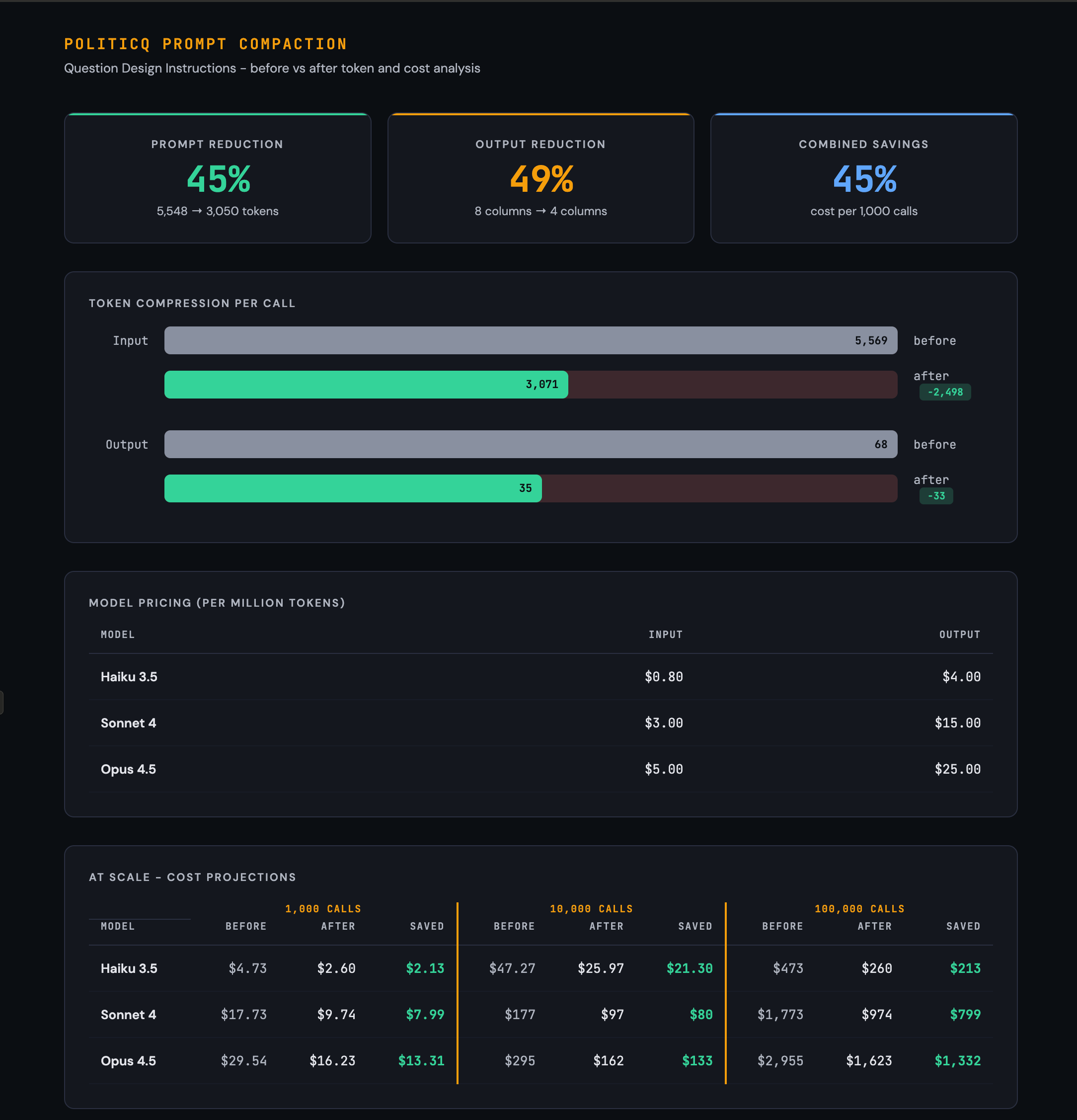
A universal meta-prompt that reduces any LLM system prompt by 40-50% without changing what it does. Only how it says it.
If you run batch LLM workloads, your system prompt rides along on every single API call. A 5,000-token prompt processed 100,000 times is 500 million input tokens. At Claude Sonnet’s pricing, that is roughly $1,500 in prompt overhead alone.
Cutting that prompt by 45% saves $675. Same outputs, same behavior, less money.
The Prompt Compactor is a meta-prompt you feed to any capable LLM. You give it your working prompt plus a sample input, and it returns a compacted version, a change log, output field analysis, and a validation report proving the compacted version produces identical results.
How It Works
You paste the meta-prompt below into any LLM conversation. Then you append two things: your working prompt and 1-3 sample inputs. The LLM applies eight compaction rules in priority order, analyzes your output fields for unnecessary columns, and validates the result against your sample.
The Eight Compaction Rules
Rules are ordered by typical savings. The first three alone usually deliver 50-60% of the total reduction.
1. Kill redundant examples ~20-25%
If a rule has 3+ examples, keep the 1-2 that best illustrate the edge case. Delete examples that merely confirm the obvious. If two examples teach the same lesson, delete one.
2. Tables to inline ~15-20%
Convert markdown tables to compact inline notation. A 5-row table becomes a single line. Example: instead of a 4-column table, write Format: ID » Output » Style » Notes
3. Tighten prose ~15%
Delete filler phrases: “It is important to note that”, “Please make sure to”, “You should always”, “In order to”. Rewrite “The output should be formatted as” to “Output format:”. Prefer imperative verbs: “Remove X” not “You should remove X”.
4. Compress checklists ~10%
If the prompt restates rules in a checklist/summary that already appeared in the body, delete the checklist. Rules exist once; do not repeat them.
5. Collapse whitespace ~8%
Remove blank lines between rules. Remove horizontal dividers. Single-space everything. One blank line maximum between major sections.
6. Compact headers ~5%
Replace verbose headers with short codes. ## RULE 7: Stem Distribution becomes R7: Stem Distribution.
7. Strip decoration ~3%
Remove bold markers (models do not need them to weight importance). Remove unnecessary markdown formatting. Keep italic or underline only if the prompt uses them as output markup.
8. Offload computation ~2%
If the prompt contains formulas or calculations that could be handled by code, flag them with [OFFLOAD] and remove. The caller can compute these client-side.
Output Field Analysis
Most prompts ask the model to echo back data the caller already has. The compactor evaluates every output field:
KEEPPrimary deliverable, required join key, or only the model can produce it
DROPCaller already has the data, value derivable from a kept field, or computable client-side
Built-in Validation
Compaction is useless if it changes behavior. The meta-prompt includes a validation step that catches drift before you ship:
1. Run the original prompt against your sample input. Note the output.
2. Run the compacted prompt against the same input. Note the output.
3. Compare field by field. Report any differences in behavior, formatting, content, or tone.
4. If differences exist, fix and re-validate until outputs match.
What You Get Back
The compactor returns four deliverables:
1 Compacted Prompt — ready to use, no commentary inside it.
2 Change Log — every change grouped by rule number with estimated token savings.
3 Output Changes — keep/drop analysis for each output field with the new format spec.
4 Validation Report — field-by-field diff proving original and compacted produce identical output.
Safety Rails
The compactor has hard constraints to prevent breaking your prompt:
Never delete a behavioral rule, constraint, or edge-case instruction.
Never merge two distinct rules into one if they govern different behaviors.
Preserve all examples that illustrate non-obvious edge cases.
Preserve the prompt’s exact output format delimiters (tabs, pipes, JSON keys).
Skip sections already under 50 tokens.
No meta-commentary added to the compacted prompt.
The Meta-Prompt
Copy everything inside the box below. Paste it into any capable LLM. Replace the two bracketed placeholders at the bottom with your prompt and sample input.
# Prompt Compactor Compact the prompt I provide below to reduce token count while preserving all behavioral instructions. Target 40-50% token reduction. Do not change what the prompt does. Change only how it says it. ## Compaction Rules (apply in order) 1. Kill redundant examples (~20-25% of savings) If a rule has 3+ examples, keep the 1-2 that best illustrate the edge case. Delete examples that merely confirm the obvious. If two examples teach the same lesson, delete one. 2. Tables to inline (~15-20% of savings) Convert markdown tables to compact inline notation. A 5-row table becomes a single line or short list. Example: instead of a 4-column table, write Format: ID | Output | Style | Notes 3. Tighten prose (~15% of savings) Delete filler phrases: “It is important to note that”, “Please make sure to”, “You should always”, “In order to”, “Keep in mind that”, “Note that”, “Be sure to”. Rewrite “The output should be formatted as” to “Output format:”. Rewrite “When you encounter a situation where” to “If”. Prefer imperative verbs: “Remove X” not “You should remove X”. 4. Compress checklists (~10% of savings) If the prompt restates rules in a checklist/summary section that already appeared in the body, delete the checklist. The rules exist once; do not repeat them. 5. Collapse whitespace (~8% of savings) Remove blank lines between rules. Remove horizontal rule dividers (—). Single-space everything. One blank line maximum between major sections. 6. Compact headers (~5% of savings) Replace verbose headers with short codes. ## RULE 7: Stem Distribution becomes R7: Stem Distribution. Drop markdown heading markers (##) unless hierarchy is essential for the model to parse sections. 7. Strip decoration (~3% of savings) Remove ** bold markers (models do not need them to weight importance). Remove unnecessary markdown formatting. Keep *italic* or _underline_ only if the prompt explicitly uses them as output markup. 8. Offload computation (~2% of savings) If the prompt contains formulas, scoring rubrics, or calculations that could be handled by calling code instead of the LLM, flag them with [OFFLOAD] and remove. The caller can compute these client-side. ## Output Compaction After compacting the prompt instructions, also analyze the output format: For every column/field the prompt asks the model to return, evaluate: – KEEP if: the field is the primary deliverable, a required join key, or only the model can produce it – DROP if: the caller already has the data (e.g., echoing back the input), the value can be derived from another kept field, or the value can be computed client-side List your keep/drop decisions with one-line justifications, then rewrite the output format spec with only the kept fields. ## Validation The prompt below includes a SAMPLE INPUT after the prompt text. Use this sample to QA the compaction: 1. Run the ORIGINAL prompt against the sample input. Note the expected output. 2. Run the COMPACTED prompt against the same sample input. Note the expected output. 3. Compare the two outputs field by field. Report any differences in behavior, formatting, content, tone, or missing/added elements. 4. If differences exist, fix the compacted prompt and re-validate until the outputs match. If no sample input is provided, select a representative test case yourself based on the prompt’s domain and run the same comparison. ## Deliverables Return four things: 1. COMPACTED PROMPT – The full rewritten prompt, ready to use. No commentary inside it. 2. CHANGE LOG – A numbered list of every change made, grouped by rule number (1-8), with estimated token savings per change. 3. OUTPUT CHANGES – The keep/drop analysis for each output field, with the new output format. 4. VALIDATION REPORT – Show the sample input, the expected output from the original prompt, the expected output from the compacted prompt, and a field-by-field diff. State PASS if outputs match or list each discrepancy and the fix applied. ## Constraints – Never delete a behavioral rule, constraint, or edge-case instruction. Compress wording only. – Never merge two distinct rules into one if they govern different behaviors. – Preserve all examples that illustrate non-obvious edge cases. – Preserve the prompt’s exact output format delimiters (tabs, pipes, JSON keys, etc.). – If a section is already compact (under 50 tokens), skip it. – Do not add explanatory text to the compacted prompt. No meta-commentary. — ## PROMPT TO COMPACT: [Paste your prompt here] ## SAMPLE INPUT: [Paste 1-3 representative inputs the prompt would process. These are used for validation only and will not appear in the compacted prompt.]
When to Use It
The sweet spot is prompts between 3,000 and 10,000 tokens. Below 3,000, the savings are real but small in absolute terms. Above 10,000, you will likely want to do a manual pass first to remove structural bloat before running the compactor.
The meta-prompt itself is about 490 tokens, so it pays for itself on the first call if your original prompt exceeds roughly 1,000 tokens.
by developer | Feb 5, 2026 | Apple, CRM, data|z
Originally posted Dec 26, 2013 on DonatoDiorio.com)
What and when to automate and when to intervene is one of the most far reaching decisions you will make on the journey to a clean CRM. In fact, this automation vs. intervention decision quandary will impact all processes in your business. Instead of an in-depth how-to-clean your CRM tutorial, I thought I’d share some simple axioms that I base my decisions on when bringing efficiency and automation to a process.
#1 Don’t confuse automation with efficiency
Efficiency is how fast and how cheap a process can be done. Automation is applying non-human processes into a system. It is a subtle difference and that is why people get confused. For example: lead assignment can be automated, but if it is being done poorly or incorrect, it is not efficient. This is a natural lead in to #2.
#2. Never automate an unsuccessful process.
People can make mistakes, but to really screw up you need a computer. Make sure your processes work correctly, regardless of how fast. Once you have your process down, then apply automation.
#3. Automate a single process at a time.
There are exceptions and sometimes you can’t avoid doing a few things at once. The reason for this is immutably tied to #4.
#4. Measure what you automate.
Define what success is so that you can recognize it when it happens. When successful, automate something else and measure again.
#5 Complex systems are constantly redesigned
No one that I know can design a complex CRM system that stays 100% to the original design. Why do major software implementations fail and go over budget? Simple, the initial design did not encompass the complexities of the real world. Balance design with diving in and checking your premises. Be agile, be creative and get user feedback at critical milestones.
by developer | Feb 5, 2026 | Apple, Philosophy
Originally posted Oct 8, 2011 on DonatoDiorio.com
What happens to my iTunes music after I die?
It’s been something I’ve been thinking about. Now that Steve Jobs has left us, it’s come to the top of my mind. For months I’ve been looking on iTunes at the Beatles complete collection. It is around $100, a $9.99 download does not make be think, but $100 makes me stop and contemplate.
When I die… can I leave my vast iTunes music collection to my children?
My CD’s sure, but what about digital rights? I’m not sure if anyone is having this conversation. What about divorce? Who gets the iTunes? After reading the lengthly iTunes user agreement, it is unclear. So in preparation, I changed my official iTunes email login to a family-oriented email. If I get hit by a train, my family will have control of my music and Apps. This made me look at copyright lengths. UK Copyright lengths are 50 years. What that means is that:
Sgt. Pepper’s Lonely Hearts Club Band, Copyright June 1967 will be free to copy in June 2016. Unfortunately, this will be in the UK only. The US copyright has been extended to 95 years. How to resolve the US/UK difference? I’m sure the Beatles copyrighted music and the US and UK, but it is interesting to think about.
This made me think more. Is this why bands keep releasing “remastered” sound tracks? A new soundtrack means another 50 years copyright. That is every band’s right. It is also my right to hold on to orginal CD’s of non-remastered recordings until they pry them out of my cold dead hands.
What it all comes down to is that there will be many more discussions on digitial music and video rights. It is interesting. I just want to live long enough to learn to play Stairway to Heaven and then use the sound track for a really cool product release…royalty free.
by developer | Feb 5, 2026 | LinkedIn
95% of LI outreach over one paragraph is **perceived** as spam. Think about that before sending. 99% for first outreach that includes a calendar link. Now called a “pitch slap.”
Pitch slap formula:
Intro/Who they are
What they do
Who they helped “companies like yours” but rarely true
Calendar link
After my supposition, I went and researched and found this article. My hunch is off by 0.12% (luck?)
https://blog.engagekit.io/linkedin-response-benchmarks-2025/
from Claude (I do the writing, Claude provides commentary)
The response rate math tells the whole story. The average LinkedIn DM reply rate across all outreach types is 10.3%. That means roughly 90% of messages get no reply at all. For InMail specifically, the average lands around 6.38%, and sales/marketing professionals see reply rates of only 6.32-6.40% because they recognize every tactic in the book. Single-action direct messages, the ones designed to prompt one specific action (like booking a call), have just a 4.88% reply rate.